

Egg Freezing Guide
Who considers egg freezing, how the process compares to a mini IVF cycle, why age and egg numbers matter, and why freezing is not a guarantee.

Egg Freezing Guide: What Elective and Medical Freezing Involve
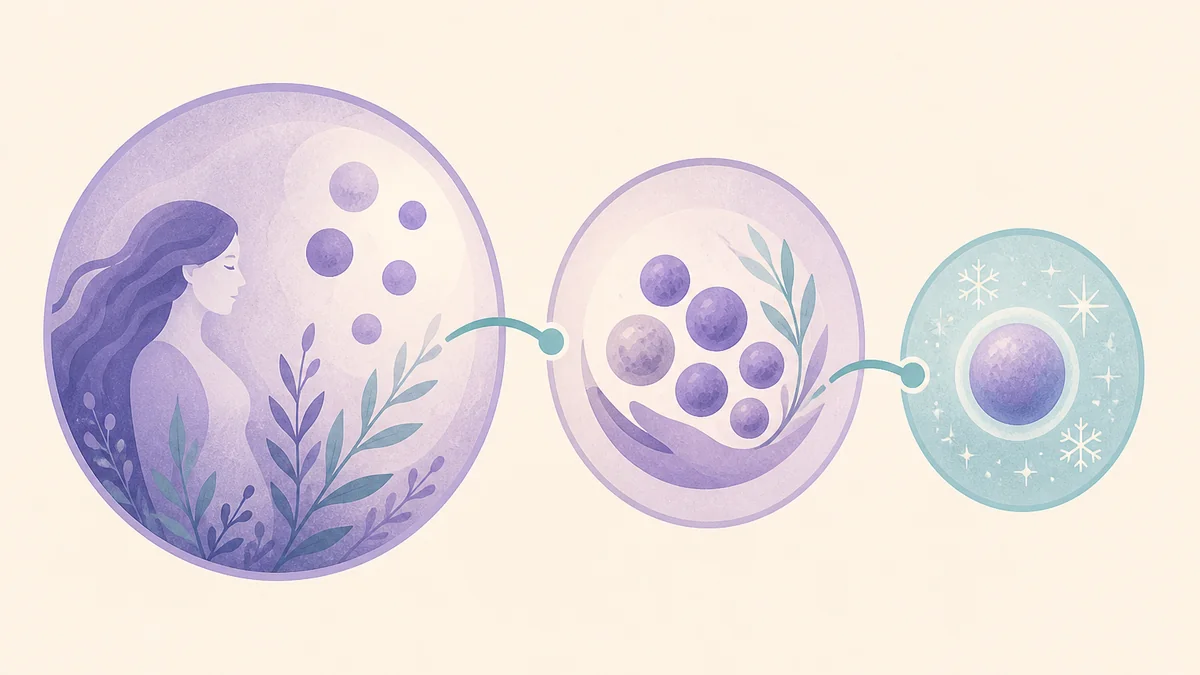
Egg freezing (oocyte cryopreservation) stores mature eggs at very low temperature for possible use later. People consider it for medical reasons (such as before some cancer treatments) or for planned delay of pregnancy. This guide explains the idea in plain language. It is not a promise that frozen eggs will lead to a baby.
Disclaimer: This article is for general education only. It is not medical advice, a diagnosis, or a treatment plan. Always discuss your situation with a licensed clinician. IVF Directory lists publicly available clinic information and does not provide success rates or pricing as clinical recommendations.

Who considers egg freezing?
Common situations include:
- Medical fertility preservation before treatments that may reduce ovarian function.
- Elective or planned freezing when someone wants more time before trying to conceive, understanding that biology still ages.
- Other clinical reasons your specialist may discuss (for example, certain genetic or medical contexts).
Laws, funding, and age limits differ by country and clinic. Ask what is offered where you live.
How the process works (like a mini IVF cycle)
In broad terms, egg freezing often includes:
- Consultation and tests — ovarian reserve markers, ultrasound, and health screening as indicated.
- Ovarian stimulation — medicines encourage several eggs to mature in one cycle, with monitoring.
- Egg collection — a short procedure under sedation to retrieve eggs.
- Freezing (vitrification) — laboratory staff freeze mature eggs using modern rapid-freeze methods when available at that clinic.
- Storage — eggs remain in supervised storage under clinic and regulatory rules.
- Later use — eggs are thawed, fertilised (often with ICSI), and any resulting embryos may be transferred after further preparation of the uterus.
The stimulation and collection steps resemble part of an IVF cycle; fertilisation and transfer happen later if and when you choose. For IVF stages overall, see what IVF is.
What “success” depends on
Patient information from ASRM and ESHRE emphasises that outcomes after egg freezing depend strongly on age at freezing and on the number of eggs stored, among other factors. Freezing earlier generally preserves higher-quality eggs than freezing later—but individual results vary, and there is no guarantee of a live birth.
Thaw survival, fertilisation, embryo development, and pregnancy all involve further steps where eggs or embryos may not continue. Cumulative chances improve with more usable eggs for some people, yet more is not automatically safer during stimulation—your team balances goals and medical risk.
Do not treat marketing slogans (“freeze your future”) as clinical forecasts. Ask for age-banded counselling based on published evidence and your own test results—not invented percentages from blogs.
Costs and logistics (they vary)
Fees may cover stimulation monitoring, collection, freezing, and an initial storage period—then annual storage thereafter. Medicines are often separate. Quotes differ widely by country and clinic. See IVF costs and financing for which questions make packages comparable. This site does not publish fixed prices.
Ask about:
- How many eggs the clinic hopes to freeze in one cycle for someone with your profile—and what if fewer are retrieved.
- Storage duration, transfer of eggs to another clinic, and consent if life circumstances change.
- What happens financially if a cycle is cancelled for safety.
Emotional and practical notes
Egg freezing can bring relief and also pressure (“I should have done this sooner”). It is a tool, not a moral test. Counselling resources and organisations such as RESOLVE can help you think through timing without shame.
If you are comparing clinics in Spain, browse Madrid, Barcelona, or Valencia on IVF Directory, then verify laboratory methods, storage rules, and teaching for medicines directly.
Questions worth asking
- Based on my age and tests, how should I think about egg freezing realistically?
- Do you use vitrification, and how do you counsel on thaw and fertilisation steps later?
- What monitoring and OHSS precautions apply to my cycle?
- What are storage fees after the included period?
- If I use the eggs later, what additional steps and costs should I expect?
The CDC reports on assisted reproduction more broadly; egg freezing decisions still need personalised clinical advice.
Further reading (primary sources)
- ASRM — Patient resources — Patient education from the American Society for Reproductive Medicine.
- ESHRE — Patient information — European patient-facing fertility information from ESHRE.
- CDC — ART — US public explanations and reporting on assisted reproductive technology (including IVF).
- WHO — Infertility fact sheet — Global definition and context for infertility from the World Health Organization.
- RESOLVE — The National Infertility Association — Peer support, advocacy, and education for people facing infertility.